




Top 10 times tables practice activities
Discover 10 fun activities and techniques shared by year 4 teachers, perfect for preparing pupils for the Multiplication Tables Checks.

Times tables are the bedrock of all successful mathematicians and with many pupils being assessed on them in the form of the multiplication tables check, we thought we'd bring you some tried-and-tested tips and techniques. The following have worked wonders in Year 4 classrooms over the years.
10 activities to help practise times tables
Flashcards and mnemonics
An old favourite, flashcards are timeless for a reason. Create sets for multiplication and add mnemonics or rhymes. Associating numbers with memorable phrases or amusing images can make the learning process more enjoyable and help pupils conquer the more challenging times tables.
Sing the Tables
Songs stick! There are plenty of published ones available to buy, or you can compose your own in class to your pupils' favourite tunes.
Gamify it
Nobody ever said that this shouldn’t be fun! Games like bingo, multiplication war and loop cards are low-key ways to add some fun while reinforcing those multiplication skills. It's a friendly competition that can transform multiplication into something a bit more exciting. Plus, the kids absolutely love it.
Timed drills
Dedicate a few minutes each day to timed multiplication drills. Emphasise the importance of speed and accuracy, mirroring the conditions of the actual Multiplication Tables Checks. Start off nice and easy and, if things are going well, gradually increase the difficulty to challenge pupils and build confidence.
Multiplication tables fact sheet
Download your free copy of our Multiplication Tables Check Fact Sheet that highlights the toughest times tables for the 25/26 cohort.
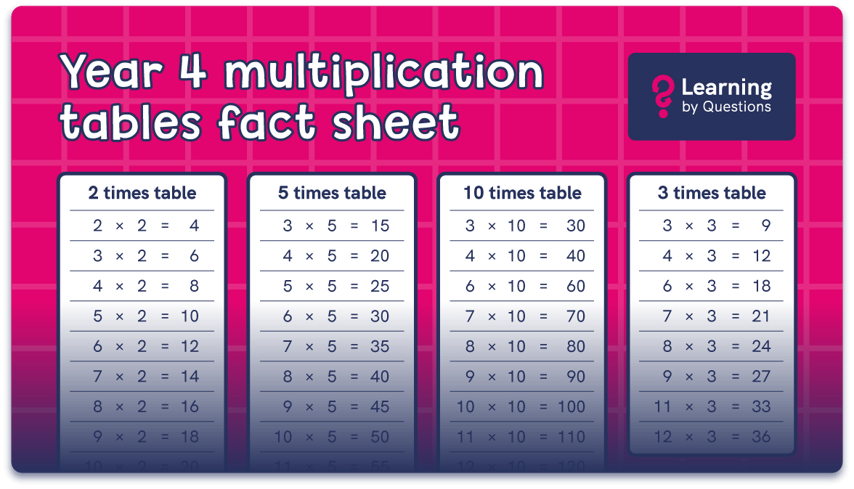
Your download should open automatically, but if not, you can open the file manually. Be sure to join our mailing list for more insightful content.
Buddy up!
Foster a supportive learning environment by pairing up students with varying multiplication strengths. This not only builds a sense of togetherness and camaraderie, but it also reinforces learning through teaching.
Related content
Year 4 Multiplication Times Tables Checks 2026: all you need to know
Art Activities
Use activities which reveal a hidden picture when the multiples are shaded in. Similar activities using various number squares reveal the patterns of times tables when the multiples are shaded.
Take it outside
Address the age-old question, "Why do I need to learn this?" by showcasing the real-world applications of multiplication. Connect it to everyday scenarios like shopping, cooking, and measuring. Suddenly, it becomes an integral part of their daily adventures. If it’s important to them, it is more likely to stick.
Say it as you do it
When you ask pupils to write out their multiplication tables for memorisation, many of them become quite crafty and adopt a systematic approach in doing so. Something like this...

This is very time-efficient, yet the key facts that need to be committed to memory are never processed cognitively as one fact but in separate parts. An over-reliance on always counting up in multiples causes many issues going forwards, not least that pupils simply won’t have the time to do this in the MTCs or any subsequent assessments.
Instead, try encouraging pupils to write out full facts in their entirety (e.g. 7 x 8 = 56). As they write, ask them to also say the full fact out loud. By doing this, the pupils experience the key fact in multiple ways at the same time: physically, verbally, visually and audibly. This helps key facts stick much more!

Spelling techniques can help!
Yes, we said it; techniques effective for spelling can also apply to times tables. Even the old-school classic ‘Look, say, cover, write and check’ technique can work wonders - just focus on a few key facts each time and keep revisiting these few facts each day until they are embedded in long-term memory.
Make it interactive
Utilise interactive learning tools to make times table practice more enjoyable.
Platforms like Learning by Questions (LbQ) offer MTC-style resources, providing an engaging and interactive way to reinforce times tables knowledge. As LbQ is an online platform, it allows pupils to get used to the formats of the checks themselves. You can also limit the amount of time that pupils complete a set of questions to mimic the test conditions.
Trust us; it gives pupils the practice and support that they need and they won't even realise they're learning.
You can gain free access to a library of Multiplication Tables Check resources and a wealth of KS2 mastery and practice materials with a no-obligation LbQ trial.
8 at-home times tables practice activities to share with pupils and parents
Kitchen maths
Utilise any opportunity in the kitchen to practise times tables. Baking cookies? Double or halve recipes together. Consider playing around with portion sizes or use the times tables to decide on what’s needed for the shopping list.
Supermarket maths
An extension of the above. Look for products with round numbers that you can mix up to create fun multiplication opportunities, e.g. “This box of biscuits has 2 rows and 8 biscuits in each, how many biscuits are there?”
Use a walk to chant
As you walk, with each step, chant the times tables out together. You can clap or stomp, perhaps emphasising the difficult ones.
Fact of the week
Choose one tricky times table fact (perhaps from the table above) and make it the fact of the week. Keep returning to the question over and over that week. This targetted approach reduces overwhelm by isolating the ‘hard’ ones.
Quiz master
Flip the tables and allow the pupil to be the ‘expert’. They can quiz family on their knowledge of times tables and correct them when they’re incorrect. This helps to build confidence and ownership in a fun role-reversal way.
Beat your best
Set a time, pick a times table (or do a mix!) and challenge the pupil to beat their previous day/week’s time.
Ad-break dash
Use advert breaks in TV shows (or on YouTube!) to do some quick-fire questions.
Fortune teller times tables
Make a paper fortune teller and write answers on the outer flaps and problems on the inside. They can play by choosing and solving.