




‘Struggling' to the top 3% nationally: A headteacher's blueprint for smarter school improvement
Headteacher Andy Done shares school improvement strategies that moved his primary school from struggling to top 3% in attainment. Discover a practical guide with downloadable resources.

For headteachers facing the intense pressure of rapid school improvement, the path can feel overwhelming: initiatives pile up, and teacher workload becomes unsustainable.
But what if a clear, human-focused framework could catalyse profound change? This isn't a theoretical model; it's the lived experience of Masefield Primary school.
With just three days' notice as the new Headteacher, Andy Done faced a line of eight pupils outside his office, waiting "to be told off." That moment revealed a culture in need of a complete reset. From there, a journey began, moving from that point of struggle to ranking in the top 3% of the country for attainment.
This blog is a preview of our free downloadable, School Done Smarter: A blueprint for headteachers. Inside, you’ll find the full story behind the decisions that Andy made as a headteacher with links to the documents he produced to support him and his staff. It’s a practical headteacher guide to working smarter, not just harder.
Get the full Blueprint with example policies & resources for free.
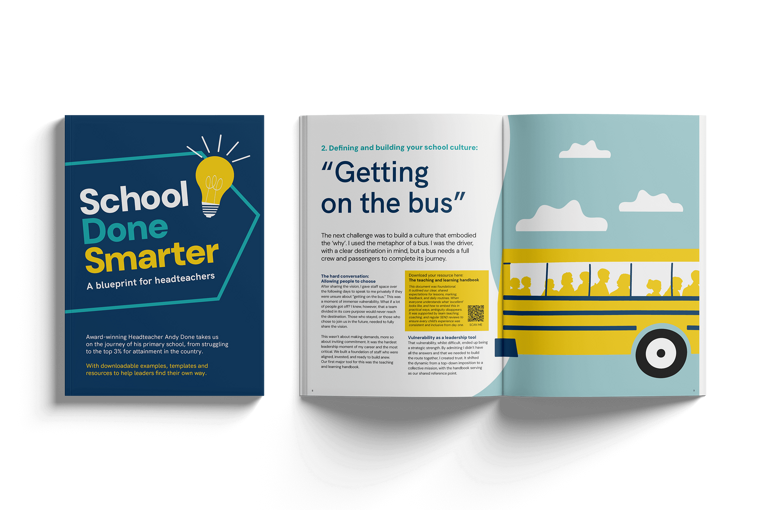
Award-winning Headteacher Andy Done takes us on the journey of his primary school, from struggling to the top 3% for attainment in the country.
Your download should open automatically, but if not, you can open the file manually. Be sure to join our mailing list for more insightful content.
Andy Done is headteacher at Masefield Primary School. Under his leadership, they implemented a core set of school improvement strategies that moved them from struggling with attainment, to the top 3% nationally for attainment. This transformation was built on a framework any school leader can adapt to.
Here is a preview of Andy Done’s guide: the five most impactful shifts you can make.
1. Find your 'Why'
Sustainable school transformation starts with being confident and absolute about your fundamental ‘Why’.
In school leadership, it is very easy to be solution orientated but without truly questioning why you are implementing specific changes. Take time to consider the challenges your school is facing and what solutions you have contemplated. Focus on the solutions and ask yourself, ‘so that…’ and keep asking until you get to your fundamental ‘Why’, your mission and your purpose as a school.
As an example, you might get to something like: to create a consistent environment where every child can thrive and progress.
Why finding your 'Why' is a foundational strategy
This "Why" becomes your non-negotiable filter. It ensures every policy, from your behaviour curriculum to your teaching framework, pulls in the same direction, creating a coherent school culture. It turns a plan into a purposeful mission that staff and pupils can believe in.
Find out more about how Andy came to his ‘Why’ and how he went about implementing change.
How to come to your 'Why?'
Get the Blueprint with downloadable examples, templates and resources to help leaders find their own way.
Your download should open automatically, but if not, you can open the file manually. Be sure to join our mailing list for more insightful content.
2. Build your culture by inviting commitment
A new vision requires a team aligned around it.
After deciding on and sharing your "Why," be courageous and give staff a genuine choice to "get on the bus", even if there’s a risk they might get off! You’ll never make it to your destination if you don’t all share the same vision for where you’re going. Vulnerability as a leader is not a weakness, it's an invitation for those around you to contribute and feel part of that ownership. It's ok not to have all the answers, but once you do, crafting a Teaching & Learning handbook can be a way of documenting and solidifying your ideas, along with practical expectations that bring the new school culture into daily life.
You'll find our handbook in the download, School done smarter: A blueprint for headteachers.
Why commitment over compliance is a foundational strategy
This approach builds a foundation of invested staff , all aligned around the same mission. The handbook is an accessible, shared reference point that eliminates ambiguity on lessons, marking, and routines, directly contributing to reduced teacher workload and consistent practice.
Get access to our Teaching and Learning Handbook and other resources we used to support change in school.

3. Engineer "embedded consistency" through systems that serve
The engine of our school improvement plan was "embedded consistency." This means creating reliable systems in three key areas that free teachers to teach.
Our three pillars of embedded consistency
- Routines & environment: For example, using colour-coded books and consistent display policies to create clarity and pride.
- Technology: At Masefield, we have had enormous success with Wayfinder from Learning by Questions (LbQ) for automated foundation subject assessment. Wayfinder provides instant feedback for pupils and zero marking for teachers, offering precise data to inform teaching.
- Teaching practice: Adopt a "doing less, better" approach with a sequenced curriculum. For example, focus CPD on perfecting core techniques like choral reading, rather than constant new initiatives.

Why embedding consistency is a foundational strategy
This coherent ecosystem removes daily guesswork and cognitive load. As the Masefield saying goes, "It's just what we do around here." It systematically reduces teacher workload while raising the quality and consistency of teaching and assessment across the school.
4. Foster belonging with a taught behaviour curriculum
Academic success is inseparable from social and emotional development. A positive school culture must be explicitly taught.
Don't assume positive behaviour; teach it. Implement a behaviour curriculum that explicitly teaches kindness, fairness, and how to play. Complement this with identity-building projects like a robust house system that’s underpinned by a shared sense of belonging for every child.
Why a taught behaviour curriculum is a foundational strategy
This taught behaviour curriculum proactively addresses the root causes of issues like the boredom encountered on day one. It shifts the focus from managing behaviour to teaching community values, giving pupils ownership and identity, which is critical for a thriving school culture.
5. Measure what truly matters: attainment and wellbeing
The ultimate test of any school improvement strategy is in its tangible outcomes for both pupils and staff.
The evidence at Masefield:
- Academic attainment: Combined scores rose from 58% to 87%. Greater depth scores went from 0% to 21%.
- Staff retention & wellbeing: By removing pointless workload and creating clear frameworks, staff felt empowered. Those who "got on the bus" have stayed, building a stable, skilled team.
Why this matters: This data proves that a focus on clarity, consistency, and culture isn't a "soft" option, it's a high-impact school transformation strategy that delivers top-tier results and a sustainable, positive working environment.
And we are in constant review of what’s working and what’s not. My next big plan is to focus on assistive technologies to ensure Masefield School makes education accessible for all.
Your real-life guide to school improvement awaits
These five interconnected school leadership strategies form a powerful framework for sustainable transformation. They demonstrate how moving from a struggling position to the top 3% is achievable through focus, courage, and systematic change.
The complete, detailed journey, with links to practical resources, is contained in the full downloadable guide: 'School Done Smarter: A Blueprint for Headteachers.'
Inside the blueprint, you’ll get:
- The full narrative of our four-year school transformation from potential forced academisation to outstanding success.
- Direct links to all our downloadable examples: the Teaching and Learning Handbook, the Sequenced Curriculum, the Behaviour Curriculum overview, and the Science Curriculum example.
- Detailed breakdowns of the systems, templates, and mindset that made each strategy work.
Begin implementing these proven school improvement strategies and start writing your own school's success story.
Get the full Blueprint with example policies & resources for free.
Award-winning Headteacher Andy Done takes us on the journey of his primary school, from struggling to the top 3% for attainment in the country.
Your download should open automatically, but if not, you can open the file manually. Be sure to join our mailing list for more insightful content.