




Parents’ guide to KS2 SATs: What to expect and how to help
Your parent’s guide to KS2 SATs 2027, sharing paper breakdowns for maths and English, what to revise and when and wellbeing tips to support your child at home.

This guide is updated annually. The information below is for the KS2 SATs taking place in May 2027.
The year 6 KS2 SATs can feel like a daunting milestone for parents and children, but they don’t have to be! This guide for parents cuts through the jargon and gives parents everything you need to support your child through the KS2 SATs confidently: think subject-specific breakdowns for maths, reading and GPS/ SPaG, advice for test anxiety and what to revise at home and when. This guide is designed specifically for parents and carers. For a more detailed administrative and curricular information teacher-orientated look at SATs, please see our Ultimate Guide to SATs.
What’s in this article?
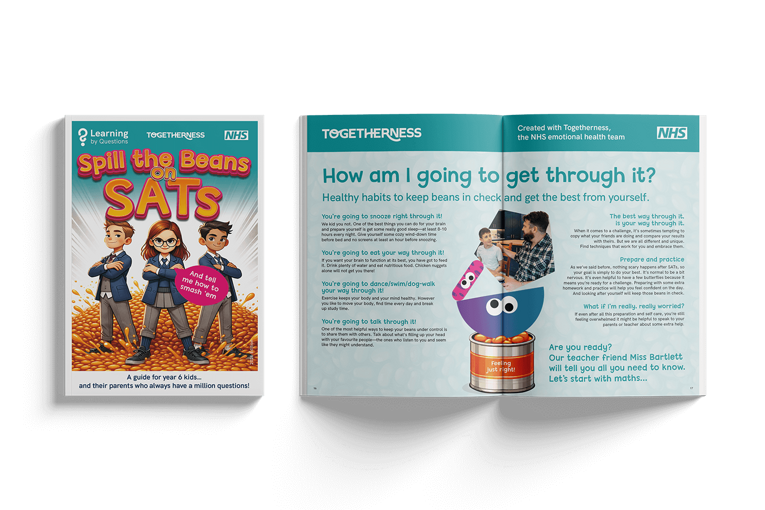
Get your copy of Spill the Beans on SATs!
Do SATs affect secondary school?
When are the KS2 SATs? Key dates for parents
What’s in the KS2 SATs papers?
What equipment is needed for SATs?
When do parents get access to KS2 SATs results?
What are the national results for KS2 SATs?
How should I prepare my child for the KS2 SATs?
What to revise at home for KS2 SATs?
Frequently asked questions from parents about SATs
Information for parents about Learning by Questions
What are the year 6 KS2 SATs?
The KS2 SATs are tests that your child will take in the second week of May, testing their knowledge in English (reading, grammar, punctuation, and spelling) and maths. They are sat by the majority of 10 - 11 year olds in England.
Download 'Spill the Beans on SATs' in partnership with Togetherness
Get this fun and informative guide to KS2 SATs for pupils. They'll get all their questions answered!
Your download should open automatically, but if not, you can open the file manually. Be sure to join our mailing list for more insightful content.
Do SATs matter?
As far as your own child is concerned, SATs give a private snapshot of how they are getting on and whether they are working at the expected standard, above or below it. It's also important to note that there are many vital things that SATs results do not measure, like being talented at sport or art or the levels of kindness they show to their peers.
As for schools, it's important to note that SATs scores are only published publicly for the school as a whole and not the individual pupils within them. As such, SATs results are reputationally significant to the schools as a key indicator of their success in helping children reach the expected standards in maths and English. Results are also sometimes used by parents in selecting the best school near them.
Do SATs affect secondary school?
SATs do not affect your child’s entry to secondary school, but they might be used to help with initial student support and setting when they arrive. Secondary schools understand that SATs are a tiny fraction of what your child is capable of and only in certain subjects: English and maths. Even if your child found the SATs difficult, there’s plenty of opportunity for them to be moved into different sets in secondary school. It’s important to note also that some schools might offer their own assessments when helping new year 7s settle in.
When are the SATs 2027? Key dates for parents
SATs 2027 happens over four days, from Monday 10th May 2027 to Thursday 13th May 2027. Both GPS/ SPaG papers will be sat on Monday 10th May, with the Reading paper following on Tuesday 11th May. The first maths paper on arithmetic will be sat on the morning of Wednesday 12th, followed up by the first maths reasoning paper in the afternoon, with the final maths reasoning paper rounding out the week on Thursday 13th May.

What’s in the KS2 SATs papers? A parent-friendly overview
Year 6 pupils in England are tested on their English (reading, grammar, punctuation and spelling) and maths knowledge in SATs week. Your child will sit 6 SATs papers in total: one reading paper, two GPS (or SPaG) papers, and three maths papers (one arithmetic, two reasoning). If you need a deeper dive into the papers and what they involve, our Ultimate Guide to SATs offers further guidance and support.
What's in the Reading SATs paper?
Children in year 6 sit one reading paper in the SATs, assessing their responses to three different texts This academic year, the reading paper will take place on Tuesday 11th May 2027:
It’s worth a total of 50 marks.
It will always have at least one non-fiction text, and at least one fiction text.
The third text is usually the toughest.
Pupils will answer a set of questions about each text. The questions will test them on their skills and knowledge in: retrieval, inference, vocabulary, summarising, author choice, prediction, comparison and contrasting.
What's in the GPS (SPaG) SATs papers?
During SATs week, Y6 children will sit two GPS/SPaG papers, both taking place on Monday 10th May 2027.
Paper 1: questions mainly focused on grammar and punctuation, but spelling is still taken into account. The test is worth a total of 50 marks, and lasts for 45 minutes.
Paper 2: an aural spelling test. Spellings are read out by the teacher and pupils note them down. There are 20 spellings, each worth 1 mark.
What's in the maths SATs papers?
Year 6 pupils sit three maths papers during SATs week, with two occurring on Wednesday 12th May 2026 and one on Thursday 13th May:
Paper 1: arithmetic (30 minutes, 40 marks, usually sat on the Wednesday of SATs week)
Paper 2: reasoning (40 minutes, 35 marks, usually also sat on the Wednesday)
Paper 3: reasoning (40 minutes, 35 marks, usually sat on Thursday - the last test of the week!)
This means that there are 110 marks available in total to be gained from all of the maths SATs papers. Your child will be assessed on their skills and knowledge in: mental maths, calculations, mathematical fluency, reasoning and problem solving.
Interested in using past papers to help with revision at home? Our blog Which SATs papers to use when has links to past papers and some good guidance. (Please note: the guidance is aimed at teachers but could also be helpful to you!)
What is arithmetic in maths?
Arithmetic in maths deals with the properties of numbers, more specifically the four operations (addition, subtraction, multiplication and division). In the arithmetic paper, your child will be given calculations without additional context or wording surrounding the question.
What is reasoning in maths?
Reasoning in maths, in short, is your child’s ability to problem-solve. It involves applying logic and critical thinking to a particular maths problem, to decide which strategies to use (and which ones not to use!) to answer correctly. In the maths reasoning papers, your child will answer word problems with additional context included in the question. Some of these are more complex, two-step problems that require multiple calculations.
What equipment is needed for SATs?
A pen, pencil, rubber and highlighter is a great place to start but we’ve compiled a full list of the equipment needed to set your child up for SATs success.

Stationery for SATs
Blue or black pens and a dark pencil: Make sure your child has plenty of blue and black pens for written sections and pencils for drawings or notes.
Rubber/eraser: Y6s are able to take rubbers into the tests, but they’re encouraged to cross out mistakes rather than erase them because they could still get marks from perceived mistakes.
Ruler showing centimeters or millimeters: A ruler is essential for underlining important info, taking measurements and drawing straight lines.
Highlighters: If it’s helpful to them, highlighters are a great way to emphasise important information for your child as they’re reading a question.
Water bottle: A water bottle is a must to stay hydrated during the exam. Make sure it's free of any information that could be seen as cheating. If someone hasn't invented a water bottle with the times tables on, they're missing a trick, but it's not appropriate for test days.
How are the KS2 SATs marked?
To understand how SATs are marked, it’s useful to remember that a scaled score is used, with 100 being the expected standard, 110 being the generally accepted standard for a greater depth of understanding and scores of 120 being the highest. A scaled score of 99 or below means the child is not meeting the expected standard, but is still considered "working towards" it. The SATs aren’t marked by teachers, but instead by external markers not associated with the school.
What is a raw score?
A pupil’s raw score in the SATs is the number of answers they got correct in the test, which is then converted into a scaled score to account for the SATs varying in difficulty over time. For example, if a test is more difficult than previous years, the raw score required to get to the expected standard will decrease.
What is a scaled score?
Scaled scores determine whether or not a child has met the expected standard for KS2. Scaled scores are created by converting a child’s “raw” score (how many marks they got in the test) into a scaled score to make sure accurate comparisons of pupil performance can be made over time.

When do parents get access to the 2026 SATs results?
You’ll be notified by the end of summer term 2026 at the latest, but it’s up to your child’s school to decide when exactly parents are given their children’s KS2 SATs results.
What are the national results for KS2 SATs?
National results for attainment in the SATs 2026 will be released in September 2026. Schools are also given a score for overall pupil progress. Because of disruptions from COVID, this will be the first year after some time that they will be published. This is arguably more important than attainment as it’s about how far the children have come whilst at school. Remember, SATs are less about marking the individual child, and more about what the school can do to improve their teaching and learning.
How should I prepare my child for the KS2 SATs?
Helping your child through the KS2 SATs is no easy task, but our free, interactive resource is full of practical strategies to support at-home prep and manage SATs anxiety. Spill the Beans on SATs, in collaboration with our pals at Togetherness, is a comprehensive guide for parents and children, covering the best topics to revise at home, healthy coping strategies for pre-test nerves and answers to key questions about SATs.
Download Spill the Beans on SATs!
Aimed at pupils, inside you'll find:
- What are SATs?
- Simple, effective revision strategies.
- Wellbeing advice to manage nerves and much more!
Your download should open automatically, but if not, you can open the file manually. Be sure to join our mailing list for more insightful content.
How can I help my child with their mental health during SATs?
To help support your child with their mental health during SATs, create a calm home environment by focusing on effort over results and remind them that SATs are just a small part of their incredible journey through school. It’s also important to prioritise downtime and sleep, to ensure they aren’t overwhelmed.
Keep in mind that anxiety is a completely normal response to stressful situations, like SATs. One tip to help your child regulate during an exam if they start to feel anxious is to count three slow breaths in, and three slow breaths out. This engages their parasympathetic nervous system to bring their feelings of anxiety back under control. Our friends at Togetherness have plenty of helpful guidance on supporting your child during stressful times, like SATs, and managing your child’s anxiety in a healthy way.

What to revise at home for KS2 SATs?
You’ll get the main list of the best SATs topics for home revision in our Spill the Beans on SATs free resource.
Spill the Beans can help you do that recap at home and in a low-stakes, engaging way. Once you feel confident with the basics, then maybe go over these tricker concepts that still have pupils puzzled in year six. Out of the 145,000 pupil answers of SATs style questions on Learning by Questions platform, we've discovered that these are the main topics that are a challenge…
English home revision list for SATs:
To hit the ground running with SATs revision in English at home, try these four troublesome topics. We’ve ranked these based on data from our platform here at Learning by Questions, taking into account 145,000 Y6 answers nationwide.
Verb tenses, progressive and perfect verb forms
Using apostrophes for plural possession
Adding suffixes -ate, -ise and -ify
Identifying the subject and object of a sentence
Key fact: Only 35.7% of Y6 children could use the present perfect correctly on their first attempt in the two months leading up to SATs 2026, a Y3 objective.
Using verb tenses and progressive and perfect verb forms is a year 3 objective, making it all the more pivotal that your child has the foundations of learning from early KS2 right out of the gate.
Maths home revision list for SATs:
Based on the common struggles of year 6 pupils across the UK, we’ve collected four tricky topics to prioritise in your at-home prep for SATs 2027.
Recognise and describe 3D shapes
Solve problems involving multiplying and adding
Translate points and describe translations
Find pairs of values in equations with two variables
Key fact: Just 31% of Y6s could count forwards in powers of 10 correctly on their first try in the two months leading up to SATs 2026.
Counting forwards in powers of ten is a pesky Y5 objective, so it’s crucial to address this topic before moving on to even more challenging year 6 knowledge.
Frequently Asked Questions from parents about SATs
Are SATs compulsory?
Yes, for most year 6 pupils, but the focus is on assessing what schools are doing well or could improve on, not the individual child. Some pupils, such as those with special educational needs or disabilities, may be assessed under different conditions, but this is ultimately at the school’s discretion!
What if my child is ill during SATs week?
If your child is ill during SATs week, they are not eligible for special consideration, but their school can apply for a timetable variation.
If something has happened that is particularly distressing to your child during SATs week or in the weeks leading up to SATs, then the school can apply for special consideration.
The government has further information on special consideration, and circumstances where this doesn’t apply.
It’s the headteacher’s responsibility to ensure your child only takes the KS2 SATs tests if they:
- are in a fit physical and mental state
- are working at the standard of the tests
- have completed the full KS2 programme of study
How can I get more help with SATs?
Your first port of call should be your child’s teacher, but we have plenty of helpful resources to help you wrap your head around the SATs.
Analysis of past papers to see what’s coming
If you’re looking for a deeper analysis of last year’s tests, our resident SATs-pert Sophie Bartlett has written insightful blogs covering all the key data points, trends and takeaways for the latest set of maths, reading and GPS/SPaG papers.
Last year’s results to spot trends
Wanting to understand 2025’s SATs results and what their implications are? Sophie’s back again with her incomparable analysis in this 2026 SATs results blog.
Resources for revision to support the run up to SATs
If you or your child are worried about SATs and need some targeted revision and focused support, Learning by Questions’ Spill the Beans on SATs (in collaboration with Togetherness) is designed specifically for children and parents. This free-to-download resource answers any worries, questions and queries you or your child might have about the upcoming SATs. We also have a dedicated blog to revision resources with a section dedicated to revision strategies to try at home.
Information for parents on Learning by Questions
Although we don’t offer parent-only subscriptions, you can be assured of Learning by Questions’ impact in your child’s classroom. Calibrated to be super effective for SATs preparation, 98% of teachers say that pupil nerves are reduced whilst 100% report even greater results. Homework is also made simple: our platform makes sure your child is assigned tailored tasks based on what they’ve been struggling with, to really get to the root of their misconceptions before they become habits. Ask your school if they use Learning by Questions and see for yourself!